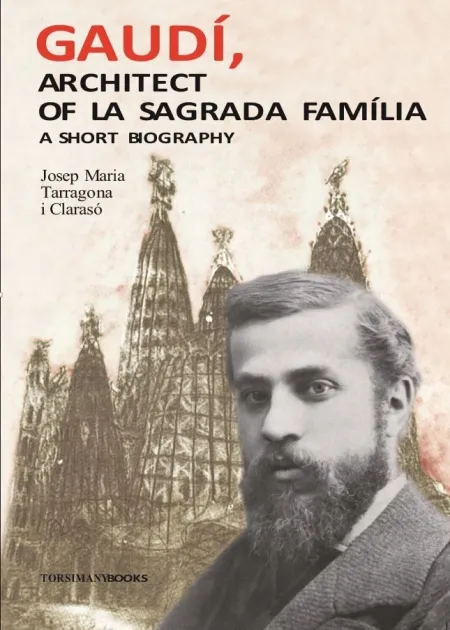
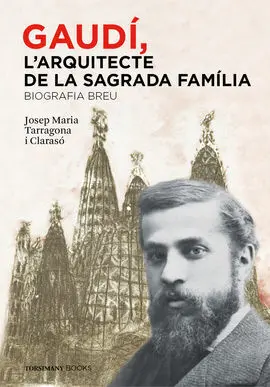
Gaudí, Architect Of la Sagrada Família
A Short Biography
Josep Maria Tarragona Clarasó
Anton Gaudí i Cornet (1852-1926) is the most popular architect in history. His architecture and plastic arts revolution laid the bases of the art of today and tomorrow. Gaudí?s work is a search for the perfection of art, for personal perfection and the perfection of human society. He expressed it thus: ?Doing a good job requires firstly, love, and then technique?. Gaudí was bo...
Anton Gaudí i Cornet (1852-1926) is the most popular architect in history.
His architecture and plastic arts revolution laid the bases of the art of today and tomorrow.
Gaudí?s work is a search for the perfection of art, for personal perfection and the perfection of human society. He expressed it thus: ?Doing a good job requires firstly, love, and then technique?.
Gaudí was born in Catalonia on 25 June 1852. He was a sickly child, and this prevented him from attending school regularly while forcing him to spend long periods in the countryside. There he grasped the Mediterranean light and the images of nature, which he would always consider his great teacher. Furthermore, helping his father, a boilermaker, in the workshop, he learned the virtues of hard work and about the transformation of flat surfaces into volumes. This greatly facilitated the development of his spatial imagination. He completed his secondary school education at the Piarist School in Reus.
During the Glorious Revolution of 1868, he moved to Barcelona to study architecture, his life?s passion. He was a bad student, but he spent hours looking at photographs of Oriental buildings and he frequented classes on philosophy, aesthetics, and history, along with concerts, classical and modern theatre, poetic readings, intellectual discussions, and visits to all the monuments and landscapes of Catalonia. Gaudí joined the Catalan Renaixença movement and would become one of its major figures.
Gaudí was aware from a very young age of his role as an art genius, and knew his ideas were no repeat nor even mere continuation of what architects had done up to that point. The only thing that scared him was that no other architect had put them into practice previously, so he would have to be the first. He had studied and discovered the geometric and constructive laws of which nature ?the masterpiece of the Creator? is made and he aimed to produce his own art using those same models, i.e. not copy Creation, but follow its course, cooperate with the Creator. From there his words: ?Originality consists of returning to the origin?.
Then he met Eusebi Güell, an important business entrepreneur with a great artistic sensitivity who understood Gaudí and became one of his best friends and his main lifelong client. Gaudí produced for Güell, among other design projects, the gates of Finca Güell, Palau Güell, the Quadra del Garraf winery, the Catllaràs Chalet and the two most creative works of his mature years: Park Güell and the Church of Colònia Güell.
Gaudí attempted to get married on several occasions, but ultimately he never married.
As a young man, he experienced at close quarters and studied in depth the problems of the working class, especially the pitiful living conditions of the proletariat. It was the time of the First International, with the socialist tendency of Marx and the anarchist trend of Bakunin. Gaudí was the architect of the worker?s cooperative La Obrera Mataronense, which advocated bringing together capital and work in a single element: the cooperativist worker. La Obrera Mataronense was the first factory in Catalonia and one of the first in the world to be owned by its workers.
At the age of 31, in 1883, Gaudí was commissioned to continue with the building work on the barely commenced Sagrada Família. He transferred his office there and for forty-three years, until his death, devoted all his energy to developing, in the design of this basilica, his ideas on structure, form, and symbolism, merged into a synthesis of rational forms extracted from nature.
Gaudí was friends with various clergymen who were innovative in their approach to society and to Church liturgy: the poet and priest Jacinto Verdaguer; Joan Baptista Grau i Vallespinós, Bishop of Astorga, who commissioned him with the Episcopal Palace; Enric d?Ossó, founder of the Teresians, who commissioned him with the order?s Central School; Pere Campins, Bishop of Mallorca, who commissioned him with the reform of the Cathedral, etc. Outstanding above all of them was his friendship with Josep Torras i Bages, Bishop of Vic, and Christian ideologue of the Renaixença in Catalonia.
Gaudí combined his work on La Sagrada Família with other commissions, large and small, not just ecclesiastic design projects or work for Güell, but for other customers too. These included El Capricho, Casa Vicens, Casa Calvet, Casa Batlló, Bellesguard, and La Pedrera.
His religiousness intensified progressively with the years. Thus, during Lent of 1894, at the age of 42, he went on a fast that was on the verge of killing him. In 1906, at the age of 54 years, he moved to live at Park Güell. Every morning he would leave his house and walk down to the parish church of Sant Joan de Gràcia to take part in the Eucharist and then continue on to the Sagrada Família. Every evening, when he finished work, he would visit the Church of Sant Felip Neri to practice his personal daily devotions. Convinced that without sacrifice no work can be successfully brought to fruition, he committed himself to a life of penitence and voluntary poverty.
Gaudí had made clear his desire to die at a Christian charitable hospital, like any other poor person. God granted him his wish. On Monday 7 June 1926, he was hit by a tram. Since nobody recognised him and because he was humbly dressed, he was taken as a poor person to the Hospital de la Santa Creu. Three days later, surrounded by his friends, he uttered his final words: ?My God! My God!?
His burial was a mass gathering, which accompanied the deceased from the hospital to the crypt of La Sagrada Família, where he is buried.
Reseña del Editor
Otros libros del autor

Artículos relacionados